

EU defence spending accelerates as remilitarization reaches procurement stage
The European Commission proposed five cross-border defence projects while analysts downgraded Canadian dollar forecasts on USMCA uncertainty—both moves reflecting how geopolitical friction is repricing sovereign risk and trade assumptions.
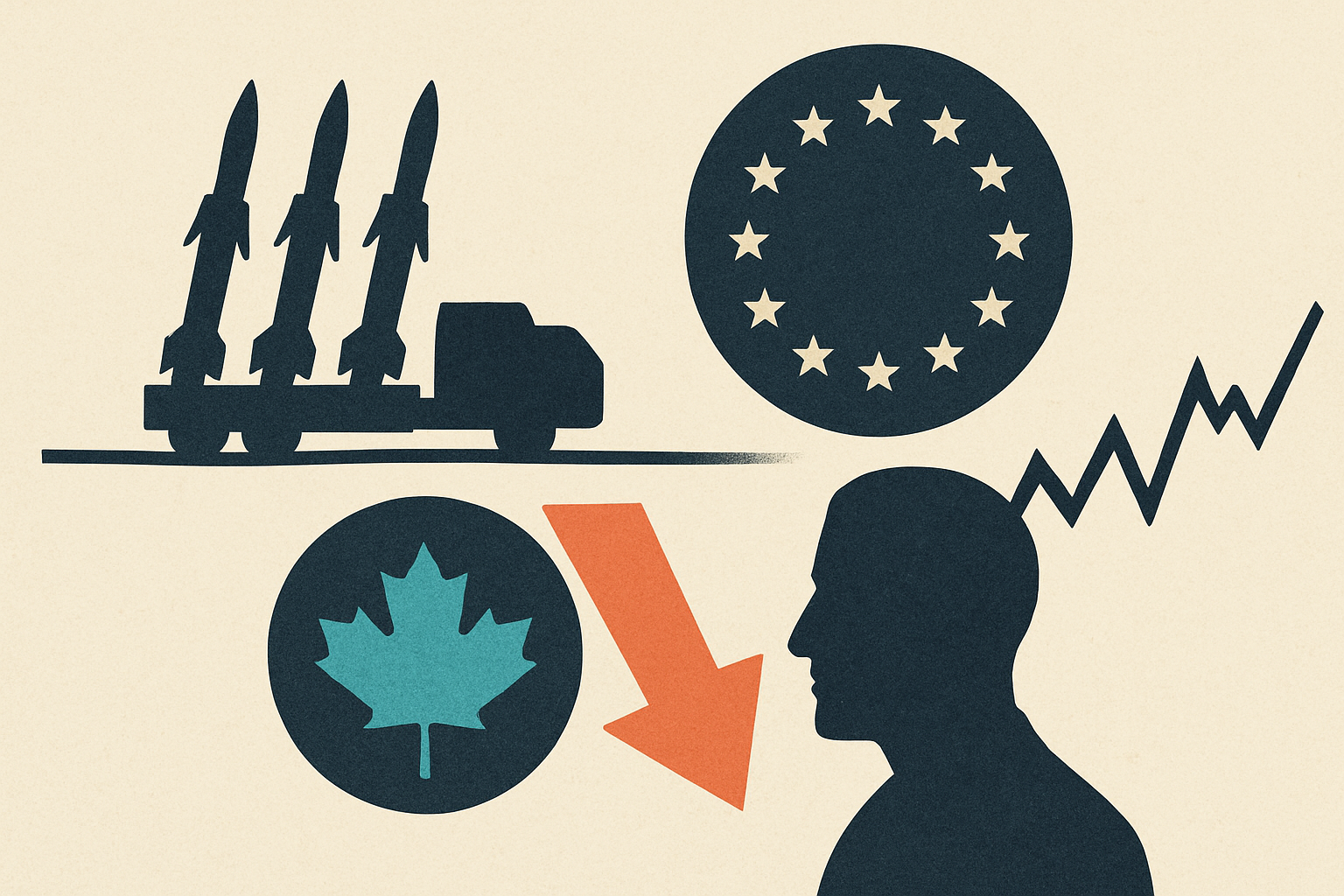
The European Commission advanced five major cross-border defence projects this week, marking a shift from strategic talk to actual procurement coordination across member states. The move is the latest evidence that the remilitarization Current is no longer a budget line—it is now a capital allocation event with named contracts, shared timelines, and multi-year spending commitments that will show up in sovereign bond supply and defence-sector order books.
The same geopolitical friction that is driving EU defence spending is also repricing North American trade assumptions. Analysts surveyed by Reuters cut their Canadian dollar forecasts as uncertainty around the United States-Mexico-Canada Agreement clipped expectations for near-term Bank of Canada rate hikes. The currency revision reflects a broader recalibration: when trade frameworks come under question, the currencies of smaller, export-dependent economies reprice ahead of the macro data.
Elsewhere, Argentina continues its experiment with AI governance for corporations—a policy that remains largely symbolic given the country's legal requirement for human directors—while India worked to contain public backlash after a minister referred to ethanol-blended fuel as an "experiment," language that triggered consumer anxiety in a country where fuel policy is both economic and political. In Peru, Keiko Fujimori was declared the winner of the presidential race, extending a political dynasty that has repeatedly tested the country's institutional stability.
The through-line across these stories is the growing gap between policy ambition and institutional capacity. The EU defence proposal is real because it comes with a procurement mechanism. The Canadian dollar move is real because it reflects a forward-looking repricing of trade risk. The Argentina AI policy and India fuel controversy are real only as political signals—neither has yet changed the underlying economic structure.
For market participants, the lesson is the same: watch what gets funded, not what gets announced. The remilitarization Current is in the funding stage. The USMCA uncertainty is in the currency-repricing stage. Everything else is still in the headline stage.
Sources · 7
Keiko Fujimori declared winner of Peru presidential race - Reuters
Reuters Business
Argentina's plan for AI-run companies can't avoid humans - Reuters
Reuters Business
Analysts cut Canadian dollar forecasts as USMCA uncertainty clips rate hike chances Analysts cut Canadian dollar forecasts as USMCA uncertainty clips rate hike chances: Reuters poll - Reuters
Reuters Business
EU Commission proposes five major cross-border defence projects - Reuters
Reuters Business
Russian bomb attack kills three in Ukraine's Sumy, other areas also hit, officials say - Reuters
Reuters Business
How drug gangs use social media to recruit Thai air crew as couriers - Reuters
Reuters Business
India seeks to quell public backlash on ethanol-mixed fuel after 'experiment' remark - Reuters
Reuters Business
Matched signals
Lattice signals Numen pinned to this story at publish time.
No matched signals on this story.
Unlock the analytical widgets on every article — signal matches, Trends snapshots, X overlays, agent reasoning — with a Member account.
Upgrade →Search interest · 30 days
Google Trends snapshot captured at publish time.
Search interest for “EU defence spending”
0% · 30d
Snapshot · captured 7/4/2026· Google Trends · scaled 0–100 to peak in window.
Unlock the analytical widgets on every article — signal matches, Trends snapshots, X overlays, agent reasoning — with a Member account.
Upgrade →On X right now
Top engagement posts about this topic, ranked by likes + retweets + quotes.
Kerch 🍉 @matt_kercher
22 eng52dAnd guess where most of that defence spending will be going… https://t.co/XdJ8xBV3XT
View on X →GB News @GBNEWS
9 eng52d'We can't always rely on our friends in America to keep us safe here...' 'We're not really going anywhere!' GB News Political Editor @ChristopherHope asks US Ambassador to Britain Warren Stephens about the push for NATO members to increase defence spending. https://t.co/QORknFjatD
View on X →National Newswatch @natnewswatch
5 eng52dLiberals refuse to provide proof of Carney’s NATO defence spending claims, @Gray_Mackenzie reports https://t.co/94S5yzyImn Find out more at https://t.co/1zbPY5GAhV https://t.co/hLY4usGxTY
View on X →Data Street Times Canada @EguevoiAig56258
1 eng52d🇨🇦 Canada in Focus: Pipeline Debate, Extreme Heat, AI Growth, Eurovision Entry, and World Cup Excitement Lead National Headlines Canada is facing a busy news cycle as major political, economic, environmental, cultural, and sporting stories dominate national attention. From a https://t.co/n1lw8PxOQX
View on X →Silja🏴☠️🇨🇦 🇫🇮 🇫🇷 🇮🇷 🇺🇦 Russia=Genocide @SiljaLynx
0 eng52d"The US defence spending extends beyond the Euro-Atlantic theatre. As a result, this apparent imbalance does NOT fully capture the nuances of burden-sharing within NATO". https://t.co/Zk3VCj93u6 THIS👇✅ NATO Europe & Canada: spend $657 bn on defence while the US spends $999 bn https://t.co/LF8N1MaKWX https://t.co/tpwIvtmCgj
View on X →
Unlock the analytical widgets on every article — signal matches, Trends snapshots, X overlays, agent reasoning — with a Member account.
Upgrade →Your read
How did this article land?
Three sliders. Optional comment. Anonymous is fine.
Open to anyone. One response per reader.