Point of View
The instrument was missing.
Every institution that intends to last has to act on futures it can't see yet. Most still plan against a single forecast. This is the case for a different practice, and for the instrument it needs.
Most organizations forecast. Almost none watch.
A forecast is a confident sentence about the future: one line on a chart, one number in a deck. Forecasts are useful. They are also brittle, and they tend to be wrong about the things that matter most.
A watch is different. It holds several futures in view at the same time and weighs the signals that move each one closer or further away. It updates as the evidence does. It doesn't pretend to know which future will arrive; it notices which ones are gaining weight, and turns that into the next decision.
The institutions that endure are the ones whose leaders learn to watch before they have to.
The practice, in four parts
None of this is new. Shell ran it in the 1970s; the best strategy teams still run it once a year, at an off-site. What has been missing is a way to run it every day.
01
Futures, not a forecast
Hold several whole futures in view at once. Cross the uncertainty you can't control with the decision you can, and you get four worlds to test a strategy against instead of one line to defend.
02
Signposts
For each future, name the signals that would tell you it is arriving: a rate, a price, a share, a count. Most signals are noise to most organizations. The work begins with knowing which ones aren't.
03
Readings
Read the signposts on a schedule, date every reading and keep score. A reading says what the evidence shows today and what would change the answer. It is meant to be revised.
04
Tripwires
Decide in advance what you'll do when the signposts line up: if this crosses that line, we revisit that plan. Then the hard decision is made calmly, before the moment arrives.
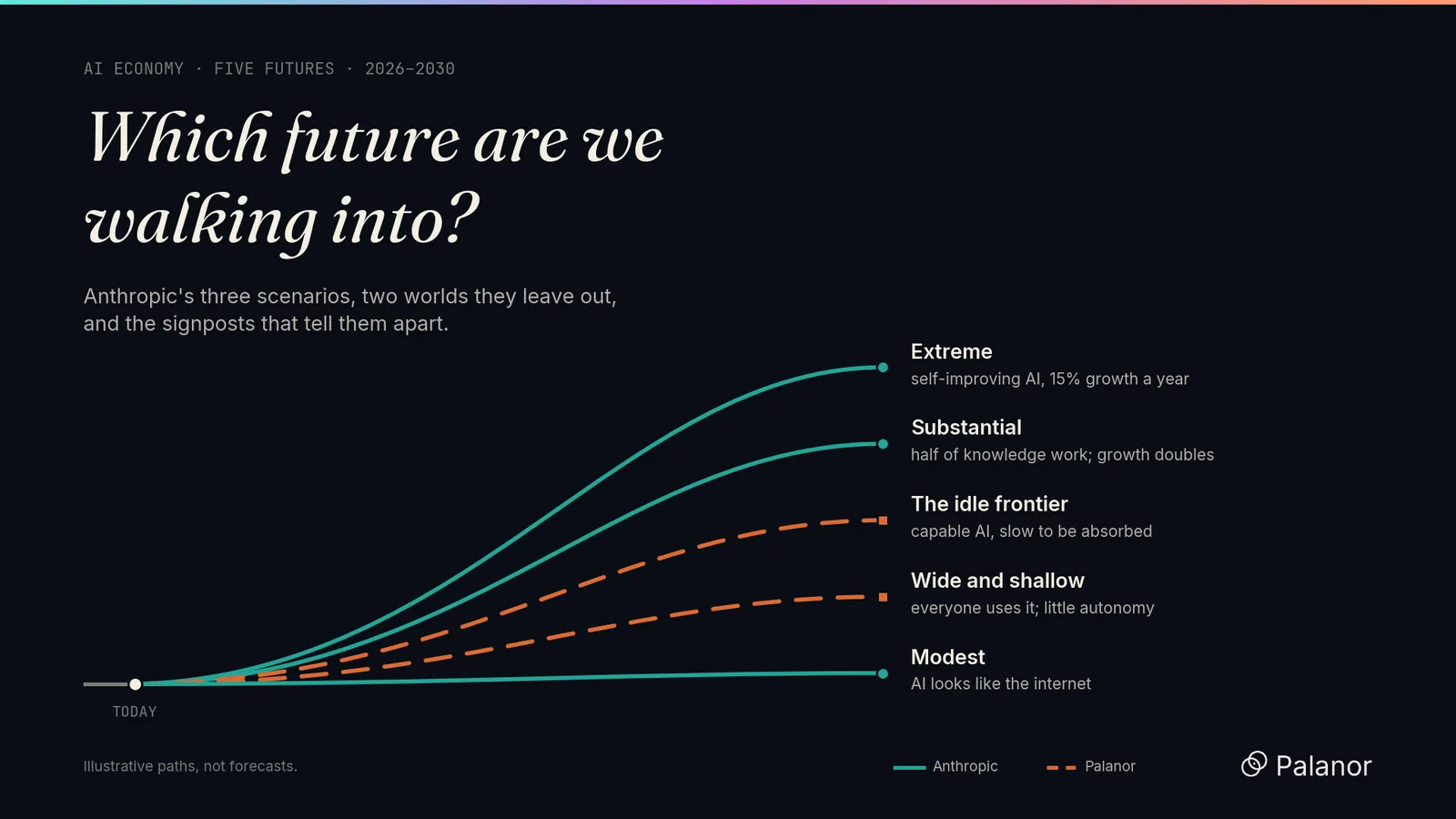
The practice, in public · OCTOBER 5, 2026
Anthropic published three futures for the AI economy. We added two, named the signposts and read them against live data.
All four parts on one real question, with every signal linked. The October reading: capability is moving faster than the economy is absorbing it, and labor's share of output is at a record low.
Read the article →
The category that did not exist
The software around the people who run organizations has never quite reached the question they ask.
- Business intelligence reports what already happened.
- Planning software builds the budget on assumptions nobody re-examines.
- Strategy software tracks goals set before the world changed.
- Prediction markets price what crowds believe, without saying what it means for you.
- Consulting delivers a deck and leaves.
Each answers a real question. None answers the one leaders actually ask: which futures are arriving, and what should we be doing about them?
That question belongs to a new category, the Enterprise Intelligence Platform, and to the discipline it serves: predictive scenario-based intelligence. Palanor is built for both.
Why now
The ground moves faster than the planning calendar. AI is changing what cognitive work costs. Capital cycles turn in quarters, not years. Trade and conflict reset supply lines with little warning. A plan built on one future breaks when a different one arrives.
Models can now read for you, if you check them. A language model can hold a company's profile in mind, read hundreds of stories and releases against it, and say what changed. Checked against its sources, that turns a watch that once took a consulting team into something that runs every morning.
The public record is deep enough. Government statistics, company filings, prediction markets and open research now publish quickly and in forms software can read. Palanor tracks 32,000+ of these signals, and every one shows where it came from.
The discipline existed. The technology and the data have caught up.
What we are building
One instrument and one agent. Palanor reads the signals that matter to an organization, scores its scenarios and Futures against them, writes its leadership a morning edition, and lets the team rehearse the hard rooms before they walk into them. Numen, the agent, does the reading and answers questions; Council, our human-led service, works alongside teams that want a partner.
We are early. The platform is live, and we are building it with our founding customers. The methodology will deepen as they use it. That isn't a roadmap; it's a practice.
How we behave
Six principles decide the questions the roadmap doesn't answer.
01
Steward, not seller.
We build for the person responsible — not the person being sold to.
02
The long view, always.
We optimize for the horizon, not the quarter.
03
Restraint is the voice.
We never alarm, never flatter, never inflate. Confidence is conveyed through precision, not adjectives.
04
Methodology is the moat.
We show our work. Customers buy ways of thinking, not black boxes.
05
Read, don't replace.
We honor the systems of record our customers already operate. Palanor's value is in what we see across them.
06
Trust, earned before scaled.
Governance, consent, and audit are built into the product before features.
On the name
Palanor echoes palantír, Tolkien's seeing-stone, through the Quenya (n)órë, land or realm: a seeing-realm. The agent is Numen, Latin for presence or spirit, the root Tolkien drew on for Númenor; we went upstream to the Latin. The people we build for are stewards: those who hold something in trust for others.
Our purpose, in one sentence:
Palanor exists to help stewards see clearly across long horizons — to keep watch over what matters, and to act with wisdom and courage.
The argument, applied