

Governments tighten content control across media
From Hong Kong bookstores to AI chatbots, authorities are extending speech restrictions into new digital territories, studies show.
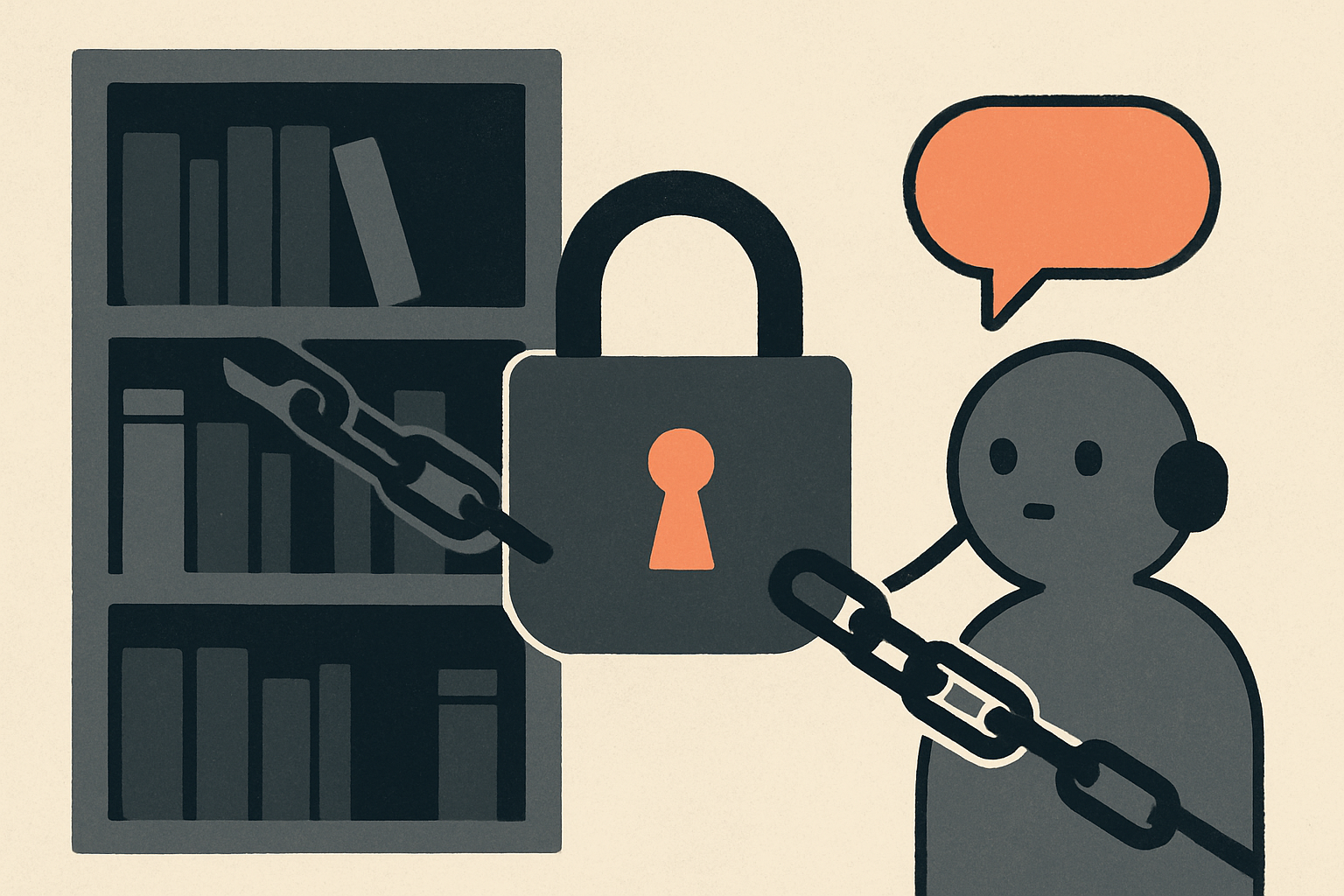
Hong Kong authorities are pressuring booksellers to ensure their titles will not harm national security following recent arrests, signaling expanded government control over traditional publishing. Officials explicitly warned bookstore operators to vet their inventory carefully, extending the city's tightening grip on speech into the literary domain. The move follows a pattern of increasing content restrictions in the territory since Beijing imposed national security laws.
Meanwhile, researchers have identified a new frontier for government speech restrictions: artificial intelligence. A recent study warns that AI chatbots are at risk of spreading and amplifying government-imposed limitations on online expression. The research suggests these automated systems could become unwitting enforcers of state censorship, potentially normalizing restricted speech across digital platforms without users realizing the constraints originate from government policy rather than technical limitations.
The dual developments illustrate how governments are adapting content control mechanisms for different media environments. While Hong Kong's approach represents direct pressure on traditional publishers, the AI study reveals a more subtle pathway where technological systems might automatically implement speech restrictions. Both pathways ultimately serve to limit what information reaches the public, though through different mechanisms.
Technology experts note that as AI systems become more integrated into daily information consumption, the potential for automated censorship grows significantly. Unlike traditional book banning, AI-mediated restrictions can be applied instantly across global platforms, making them potentially more pervasive and harder to detect. The convergence of these trends suggests governments are developing increasingly sophisticated methods for controlling public discourse across both analog and digital channels.
Sources · 2
Hong Kong official says booksellers should ensure titles won't harm national security after arrests - AP News
AP Business
C 0.00Read at source →AI chatbots are at risk of spreading government restrictions on online speech, a new study says - AP News
AP Business
C 0.00Read at source →
Matched signals
Lattice signals Numen pinned to this story at publish time.
No matched signals on this story.
Unlock the analytical widgets on every article — signal matches, Trends snapshots, X overlays, agent reasoning — with a Member account.
Upgrade →On X right now
Top engagement posts about this topic, ranked by likes + retweets + quotes.
No high-engagement X posts captured for this topic. Either the topic is too quiet or the upstream API was unavailable when this article published.
Unlock the analytical widgets on every article — signal matches, Trends snapshots, X overlays, agent reasoning — with a Member account.
Upgrade →Your read
How did this article land?
Three sliders. Optional comment. Anonymous is fine.
Open to anyone. One response per reader.