

Three Buildouts Collide: AI, Defense, and Default
Corporate bankruptcies are reshaping retail real estate, while capital floods into AI infrastructure and military production—each pulling inflation in different directions.
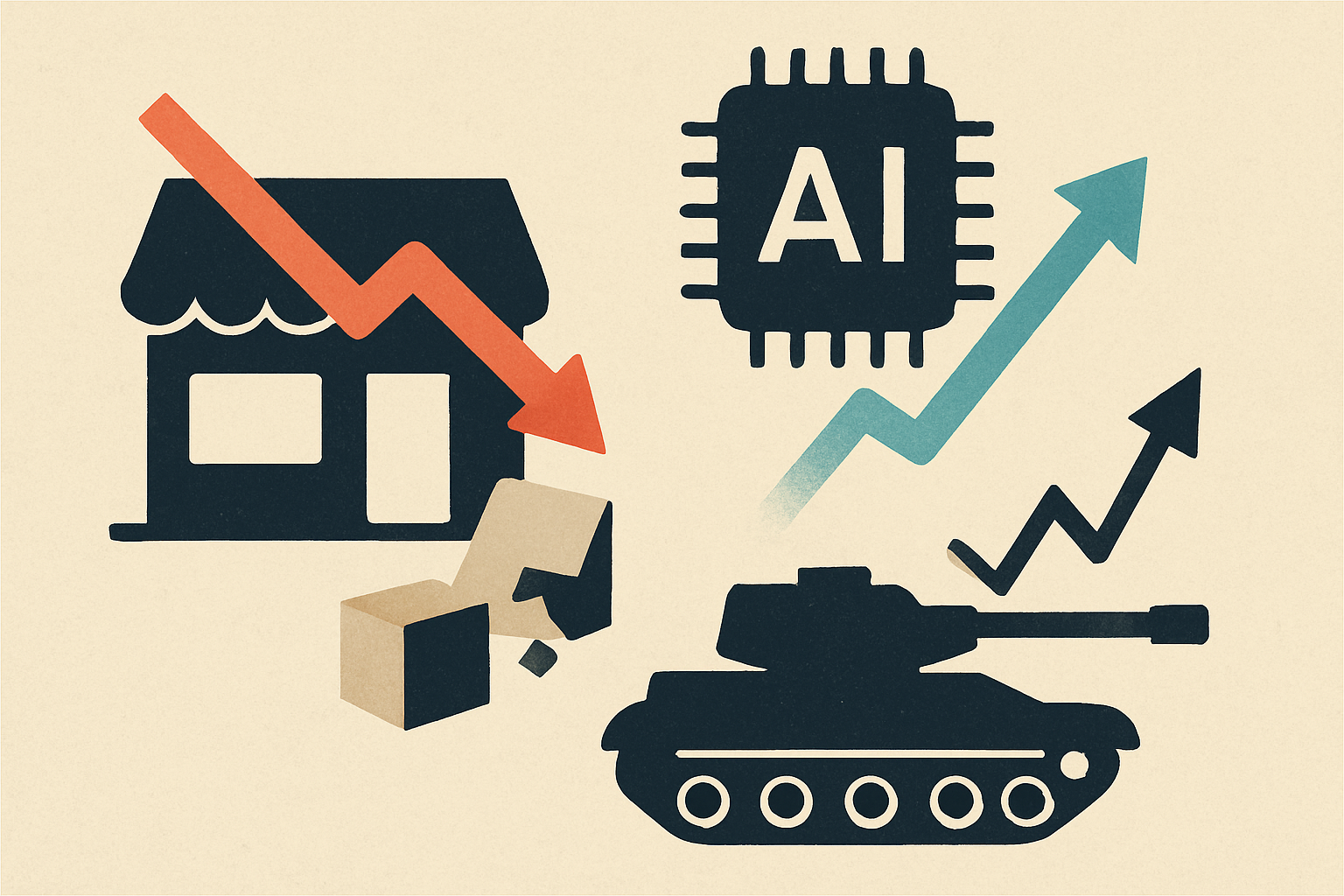
The American economy is running three parallel buildouts at once, and they are starting to bump into each other in ways that stewards should watch. One is voluntary, one is strategic, and one is involuntary. Together they are rewriting the map of where capital flows and what consumers end up paying.
The involuntary buildout is contraction. Corporate bankruptcy filings are climbing, driven by the twin squeeze of high rates and consumer taste that moved on. According to Bisnow, the result is a wave of real estate portfolio restructurings—chains shedding locations, landlords negotiating with special servicers, properties changing hands under duress. Commercial Observer notes that platforms handling distressed CMBS loans are seeing more business, with marquee assets like the Helmsley Building in Midtown hitting the block after long defaults. This is not a crisis, but it is a culling. The commercial real estate market is repricing around a new set of assumptions about foot traffic and revenue.
At the same time, two very different sectors are in aggressive expansion mode. Defense News reports that the U.S. industrial base is strengthening its capacity for wartime production, a response to conflicts that consume weapons faster than peacetime models anticipated. Factories are retooling, supply chains are being hardened, and the government is paying for readiness. Meanwhile, AP Business highlights the scale of AI infrastructure investment—data centers, chips, power grids—and the knock-on effects for consumers, who are seeing higher prices for laptops and electricity as demand for compute and energy surges.
The tension is in the timing. Real estate is deflating in some categories while defense and AI are pulling labor, materials, and electricity into their orbits. That creates asymmetric inflation: some prices fall, others climb, and the averages mask the churn underneath. For stewards, the question is not whether inflation stays stubborn—it is which sectors are bidding up scarce resources and which are quietly being starved.
The robotaxi angle, flagged by TechCrunch Mobility, adds a wildcard. If autonomous fleets scale, they represent yet another capital-intensive buildout with implications for urban real estate, energy demand, and labor. Three buildouts might soon be four. Watch the margins where they compete for the same inputs.
Sources · 5
US industrial base is becoming stronger for wartime production, study finds
Defense News
Massive AI buildout poses latest inflation threat as consumers pay more for laptops and electricity - AP News
AP Business
C 0.00Read at source →More Commercial Real Estate Owners See Value in Special Servicing Platforms
Commercial Observer
Bankruptcies Are Rising, Putting More Real Estate Up For Negotiation
Bisnow
TechCrunch Mobility: A robotaxi ultimatum
TechCrunch
Matched signals
Lattice signals Numen pinned to this story at publish time.
Unlock the analytical widgets on every article — signal matches, Trends snapshots, X overlays, agent reasoning — with a Member account.
Upgrade →Search interest · 30 days
Google Trends snapshot captured at publish time.
Search interest for “corporate bankruptcies 2025”
0% · 30d
Snapshot · captured 7/13/2026· Google Trends · scaled 0–100 to peak in window.
Unlock the analytical widgets on every article — signal matches, Trends snapshots, X overlays, agent reasoning — with a Member account.
Upgrade →On X right now
Top engagement posts about this topic, ranked by likes + retweets + quotes.
Alternative News @AlternatNews
50 eng49dGerman corporate bankruptcies hit 21-year high. Almost 5,000 companies filed for insolvency in April-June 2026, according to new data. It comes as a surprise as nobody seems to believe it. It was like this for 3 years already. The German economy contracted in 2023 and 2024, https://t.co/fiLcABMmqf
View on X →Jack Straw @JackStr42679640
13 eng52dMore Cabal's propaganda ⚡️🇷🇺🇪🇺 — A European intelligence report warned that Russia risks an explosive banking crisis as lenders bear much of the burden of the country's war economy, — According to Reuters. ➡️The report highlights that deteriorating loans, growing household https://t.co/mYIyaULHnk
View on X →trap_zack @ZackEiseman
11 eng52dICYMI O/N MACRO: Asian tech stocks slumped, as investors used Samsung Electronics Co.’s results to lock in profits on a stellar year-to-date chip rally, rotating into unloved sectors less prone to earnings shocks. (WSJ) Walmart is cutting prices on thousands of items to help
View on X →Macro Alpha @MacroAlphaHQ
1 eng52dThe Russian war machine has a hard floor at $59 a barrel. Look at the right side of the chart, Brent just puked 28% in two months down to $72. that means their flagship Urals crude is currently clearing near 42 bucks. do the math on that 17 dollar deficit. Moscow assumed $59 oil https://t.co/TcYPhFB7qP
View on X →Nataliia Kromchenko @NKromchenk4068
0 eng50dTrump is enriching detention centers owners, when his main electorate, farmers, are closing their businesses. Approximately 15,000 U.S. farms closed during 2025, according to the USDA National Agricultural Statistics Service. While it is difficult to isolate closures solely to https://t.co/v9wgXpAYvn
View on X →
Unlock the analytical widgets on every article — signal matches, Trends snapshots, X overlays, agent reasoning — with a Member account.
Upgrade →Your read
How did this article land?
Three sliders. Optional comment. Anonymous is fine.
Open to anyone. One response per reader.